

Investing in a high-end corporate wardrobe requires a meticulous commitment to care and personal maintenance. From selecting your custom wool suits to storing your Goodyear-welted leather shoes, each premium garment represents a strategic asset designed to project visual authority.
However, there is a silent and incredibly common operational failure waiting inside your laundry room that targets your finest clothing pieces. Many executives notice that after just five cycles through standard household appliances, their expensive dress socks begin to shrink dramatically, feel coarse, and slip down their legs constantly.
This structural collapse destroys your executive silhouette, forcing you to manually pull up sagging fabric throughout your active business day. At Pierre Henry Socks, we engineer our hosiery loops to withstand the demands of heavy usage, and today we break down the definitive physics of fabric care to protect your investment.
The Physics of Fiber Shrinkage: Why Low-Grade Textiles Fail
To understand why premium garments alter their dimensions, we must examine the microscopic structure of natural and synthetic threads under thermal duress. Mass-market department store socks rely heavily on short-staple cotton mixed with cheap synthetic polyester strands.
When exposed to high-velocity hot water cycles and the tumbling friction of a standard dryer drum, these loose short fibers fracture, intertwine unevenly, and cause severe fabric pilling. Even worse, the intense thermal energy pulls the molecular chains of the cotton tightly together, forcing the complete garment to shrink unevenly.
To prevent this technical breakdown, we control our raw material supply loop directly through our partner manufacturing facility, Itessa in Peru. Their master weavers execute an elite double-feed combing protocol exclusively utilizing long-staple Peruvian organic cotton fibers:
- Long-Staple Molecular Moat: Long-staple cotton fibers feature an elongated, naturally resilient structure that smoothly glides under moisture tension rather than knotting up.
- High-Density Weave Stability: Our double-feed interlocking matrix stabilizes the base dimensions of the fabric loop, ensuring your solid Black, Navy, and Charcoal lines retain their smooth opaceness after every cycle.
The Thermal Destruction of Stay-Up Recovery
The most severe damage caused by household heat appliances targets the elastic component responsible for keeping your hosiery firmly anchored below the knee. Traditional dress socks use cheap, single-ply rubber polymers woven loosely into the top cuff matrix.
When subjected to the extreme heat of a standard tumble dryer, these low-grade elastic fibers reach their thermal breakdown point, dry out completely, and develop micro-fractures. Once the structural elasticity is broken, the cuff loses its elastic memory and stretch tension, causing the material to pool loosely around your ankles.
Through our precise technical engineering partnership with Kapitex in Ecuador, we engineered a definitive mechanical solution to this operational wear. We integrated an advanced Active Memory Elastic Matrix into our signature over-the-calf (OTC) profile:
- Heat-Resilient Matrix Architecture: The Kapitex core uses multi-filament elastic strands engineered to bounce back into position, retaining shape under continuous daily movements.
- Graduated Compression Security: Designed to fit robust legs and larger frames comfortably, this upper matrix maintains a steady grip below the knee without leaving red skin indentations.
The Technical Maintenance Protocol for Premium Hosiery
To safeguard your executive drawer assets and extend their lifespan, integrate these three calculated rules into your laundry loop today:
- Enforce the Inversion Wash Rule: Always turn your organic cotton dress socks inside out before tossing them into the machine. This simple design choice shields the exterior natural fibers from direct drum abrasion, preventing pilling.
- Commit to the Cold-Cycle Moat: Wash your wardrobe staples in cold water settings utilizing gentle liquid detergents. Cold water protects the natural cotton cell walls from contracting, completely eliminating shrinkage risks.
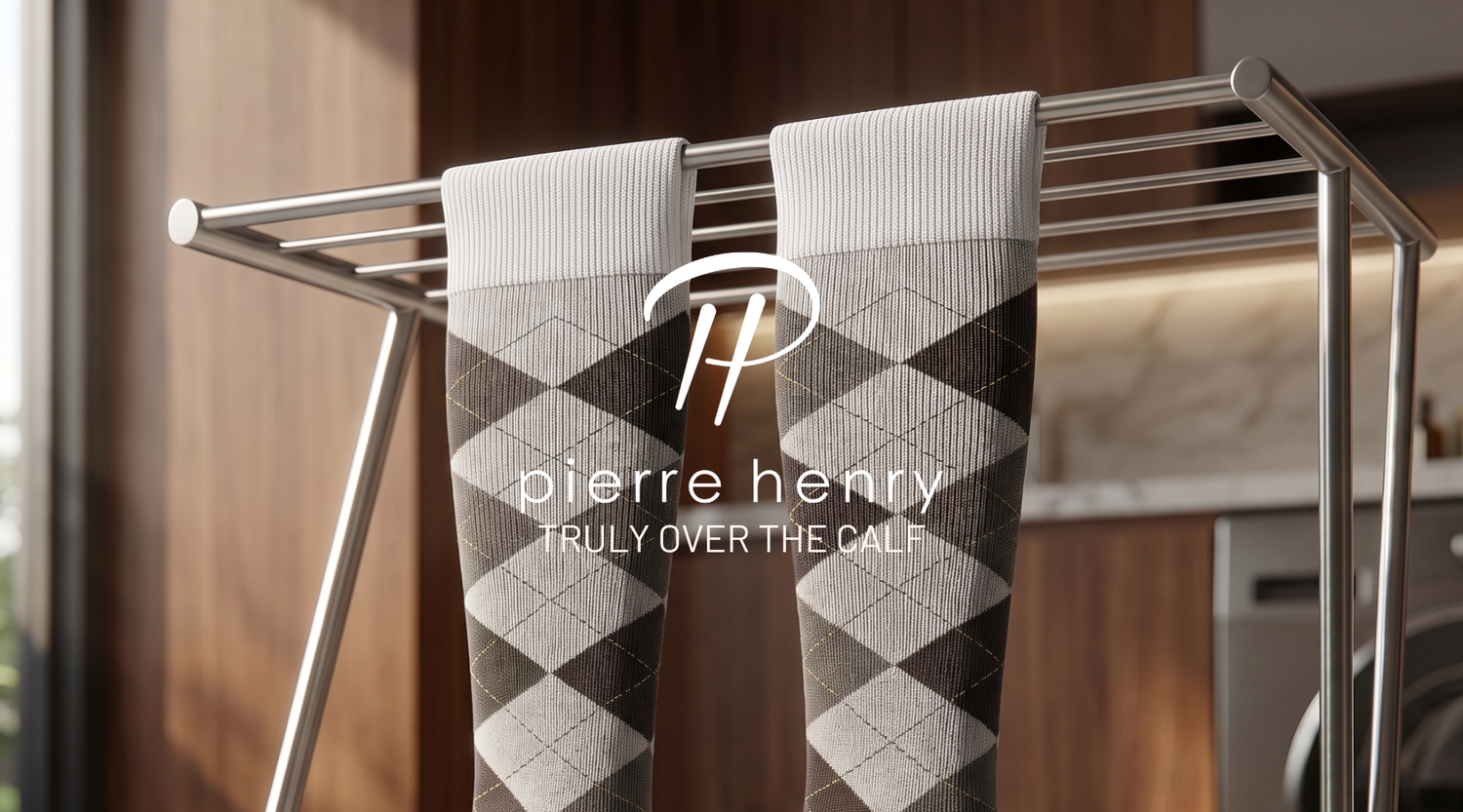
- Declare Independence From the Tumble Dryer: Hang your over-the-calf socks to air dry naturally on a flat surface or drying rack. Air drying preserves the tension of the elastic matrix, effectively doubling the structural life of your hosiery.
True leadership is reflected in an absolute refusal to overlook the minor details of your personal infrastructure. Protect your textile assets, eliminate slipping fabric distractions, and navigate every high-level meeting with absolute composure.
What is your current wardrobe care routine to maximize the lifespan and structural integrity of your premium clothing investments? Leave your operational strategies in the comments below, or explore our factory-direct multi-packs to upgrade your rotation today.



Leave a comment
All comments are moderated before being published.
This site is protected by hCaptcha and the hCaptcha Privacy Policy and Terms of Service apply.